Super Dog Diets — evidence-led guidance. Last reviewed: 1 October 2026.
Most dog owners are confident they'd notice if their dog put on weight. Yet veterinary professionals estimate that nearly half of dogs in the UK are overweight, according to PDSA — a gap between perception and reality that matters, because carrying extra weight is linked to arthritis, diabetes, breathing difficulties and a shorter life. Working out whether your dog is a healthy weight, and how much to feed them, isn't about reading a single number off a bathroom scale. It's a method — and it's one you can learn.
Dog body condition score: why it matters more than weight in kilograms
A dog's "ideal weight" varies enormously, even within the same breed, depending on frame size, muscle mass and build. A figure in kilograms tells you very little on its own. What vets actually use is body condition scoring — a hands-on, visual assessment of how much fat and muscle a dog is carrying, independent of what the scales say.
PDSA describes this as a 9-point body condition scale, and sets out the practical checks behind it. You run your hands along your dog's sides — "the skin should move freely over the ribs, which you should be able to feel with a light touch" — then along the back, where "you should be able to feel the spine and hipbones under the skin without being able to see them." You check the base of the tail, where there "shouldn't be a build-up of fat," and feel under the tummy, which "should go in, not bulge out." Finally, you look at your dog from above and from the side: a visible waist, and an abdomen that tucks up rather than hangs level with the ribcage, both indicate a healthy shape.
This same approach — structured palpation of ribs, spine, hips and tail base, combined with a visual check for waist and tuck — sits behind the body condition and nutritional assessment tools promoted internationally by the World Small Animal Veterinary Association (WSAVA), whose Global Nutrition Guidelines encourage vets to make this kind of check part of nutrition screening "at every visit," alongside a separate muscle condition assessment (which looks at wasting and muscle loss rather than fat cover).
The method matters more than memorising a number. If you can't easily feel ribs without pressing firmly, if there's no visible waist, or if the tummy bulges rather than tucks, these are signs worth discussing with a vet or vet nurse — not a basis for deciding, on your own, that your dog has a specific diagnosis like obesity. A vet or vet nurse can score your dog in person and advise on what, if anything, needs to change.
Feeding guidelines on the pack: a starting point, not a guarantee
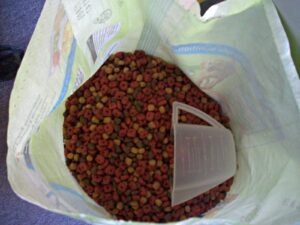
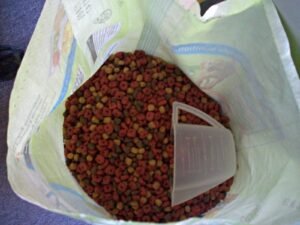
Every bag or tin of complete dog food (see our guide to dry, wet, fresh, raw and homemade feeding methods if you haven’t settled on one, and our UK dog food label guide for what “complete” actually means) carries a feeding guide, usually a table matching bodyweight to a daily gram amount. These figures are calculated from averages, and UK Pet Food — the industry body representing pet food manufacturers — is explicit that this is where you start, not where you stop: "feeding guidelines on the back of pet food packs recommend daily portions based on your pet's weight, life stage, and activity level, using scientific calculations," and the advice is to begin with the amount for your dog's ideal weight, then adjust if they gain or lose weight over two to three weeks, monitoring until things stabilise. The organisation also recommends weighing food on a kitchen scale rather than relying on cups or scoops, which are a common source of over- or under-feeding.
Crucially, UK Pet Food frames the whole exercise around body condition rather than a fixed number: your pet "should be fed to their ideal body condition score — which your vet will calculate with you." In other words, the pack guide gets you in the right region; body condition scoring, ideally checked periodically with a vet or vet nurse, tells you whether to adjust up or down from there. Two dogs of identical breed and weight can have genuinely different energy needs depending on neuter status, age, activity level and individual metabolism — there is no single correct number that applies to every dog of a given size.
Treats count towards the daily total
It's easy to treat treats as separate from "the diet," but calorie-wise they aren't. UK Pet Food's guidance is specific on this point: treats and snacks "should not form more than 10% of the whole diet's calorie content." That includes training treats, chews, dental sticks, and anything handed over at the table — not just branded dog treats. If a reasonable portion of treats is going in daily, the main meal portion needs to flex downward to compensate, or the overall daily calorie total creeps up without the feeding guide ever looking "wrong."
Puppies, adults and seniors: feeding needs shift with life stage
Energy and nutrient needs aren't static across a dog's life. Puppies are growing and typically need proportionally more energy for their size than adults, split across more frequent, smaller meals while their digestive systems mature; adult maintenance feeding is usually calmer and more routine once growth stops and weight stabilises. At the other end, PDSA notes that "older pets can be less active, meaning they don't need as much energy from their food as their younger counterparts" — which is one reason senior dogs can gain weight on a portion that suited them fine a few years earlier, even with no change in routine. The flip side matters too: PDSA is equally clear that "just as important as spotting weight gain is being able to identify if your older pet loses weight," and advises owners to "speak to your vet if your pet loses weight rapidly or you notice they have had significant weight loss." Because needs vary so much by individual, breed and health status at every life stage, PDSA's general steer is sensible for all of them: "if you're unsure, speak to your vet."
When to involve a vet, rather than managing it yourself
Body condition scoring and careful portioning are things every owner can learn to do. But there are moments where self-management should stop and a vet visit should start. These include: sudden or rapid weight change in either direction; weight loss you can't explain by a deliberate diet change; a dog that seems to be gaining weight despite feeding to the pack guide and limiting treats; or any sign of a health problem that might be weight-related, such as reduced mobility, joint stiffness, laboured breathing, or noticeably reduced stamina on walks. PDSA's own advice is unambiguous here: "contact your vet for advice if you are struggling to keep your dog at a healthy weight," and, as they put it plainly, "you know your dog best, always contact your vet if you're concerned."
This isn't about being able to feed your dog perfectly from day one. It's about having a reliable method — body condition scoring, a pack guide used as a starting point, treats counted in, and a vet involved when something changes or doesn't add up. If you do change what or how much you feed, do it gradually — see our guide to switching your dog’s food safely.
Sources
- PDSA — Your dog's Body Condition Score — used for the 9-point body condition scale and the exact palpation/visual checks (ribs, spine, hipbones, tail base, tummy, waist).
- PDSA — Obesity in dogs — used for the "nearly half of dogs in the UK are overweight" estimate, associated health risks, and the vet-contact advice ("contact your vet for advice if you are struggling… you know your dog best").
- PDSA — A guide to senior pet food and feeding your ageing pet — used for senior dogs' reduced energy needs, the advice to watch for unexplained weight loss, and "speak to your vet if unsure."
- UK Pet Food — Calculating how much to feed — used for feeding guides as a scientifically calculated starting point, feeding to body condition score, and the 10% treat-calorie limit.
- UK Pet Food — Pet Size-O-Meters — used for context on Size-O-Meter body condition tools distributed to owners via vets and welfare charities (ukpetfood.org is the current, live domain for this organisation, formerly PFMA; pfma.org.uk is dead and was not used).
- WSAVA — Global Nutrition Guidelines — used for the international framing of body condition and nutritional assessment as a routine check "at every visit," and the distinction between body condition score (fat cover) and muscle condition score (muscle mass).
Every source listed above was individually fetched and its content checked against the specific claims and quotes used in this article on 1 October 2026. Two additional sources were investigated but not cited: a PDSA PDF factsheet on weight loss in dogs and a FEDIAF nutritional guidelines PDF both returned as unreadable binary/image data when fetched, so no claim in this article relies on them. No Blue Cross, Dogs Trust or RSPCA page with directly relevant, verifiable content on this specific topic was located during this research session, so none is cited here.